| ||||||
| 1. The Lead — we finally have a picture of “verified” |
| The most useful finding this week is the constructive answer to last week’s warning. A new peer-reviewed study — “AI-enabled energy baselines for verified building decarbonization” (Scientific Reports, Nature portfolio, Jan 2026) — pairs an LSTM + XGBoost model with Singapore’s Energy Conservation Calculation method to build continuously-updated dynamic baselines across ten commercial, residential and mixed-use buildings over three years (2021–2024). The results that matter: baseline prediction error generally under 5% (avg 4.9%), 3,221 tCO₂e of cumulative reductions, a retrofitted hotel running 56–61% better than its 2005 benchmark — and, the part that makes it credible, outcomes independently confirmed by the Singapore Building & Construction Authority and cross-checked against utility-meter data. Read it next to February’s overestimation paper (arXiv:2602.22499) and the thesis is complete: stop buying the headline percentage; buy the method — whole-building, dynamic-baseline, third-party-auditable. |
| 2. The Numbers |
|
| ||||||||
|
| 4. Capital Markets — the money got bigger; the asset class shifted |
| Four hyperscalers now guide to $725B of 2026 capex (+77% YoY), roughly $450B of it AI-related. Microsoft’s CFO attributes ~$25B of its own increase to rising memory and component costs — even the inflation is partly scarcity. The capital-markets story underneath: data centers are becoming a financing asset class. US completions are set to more than double to 76.1M sq ft in 2026 (CoStar), and stabilized hyperscale facilities are increasingly funded through single-asset, single-borrower CMBS. The legacy fracture line is unchanged — office still carries a record 12.34% CMBS delinquency against multifamily’s 0.5% — but the new money is being built, and financed, around power. |
|
|
|
| 6. Sector Watch |
| Data centers stay the asset class of the cycle — but the binding constraint is electricity, not chips, and completions are now outrunning the grid’s ability to power them. Office remains two assets sharing a name: trophy tightening, commodity in runoff at 12.34% delinquency. Quiet winners: multifamily (0.5%), industrial, medical office — rolling over with a haircut, not a default. |
| ||||||||||||
|
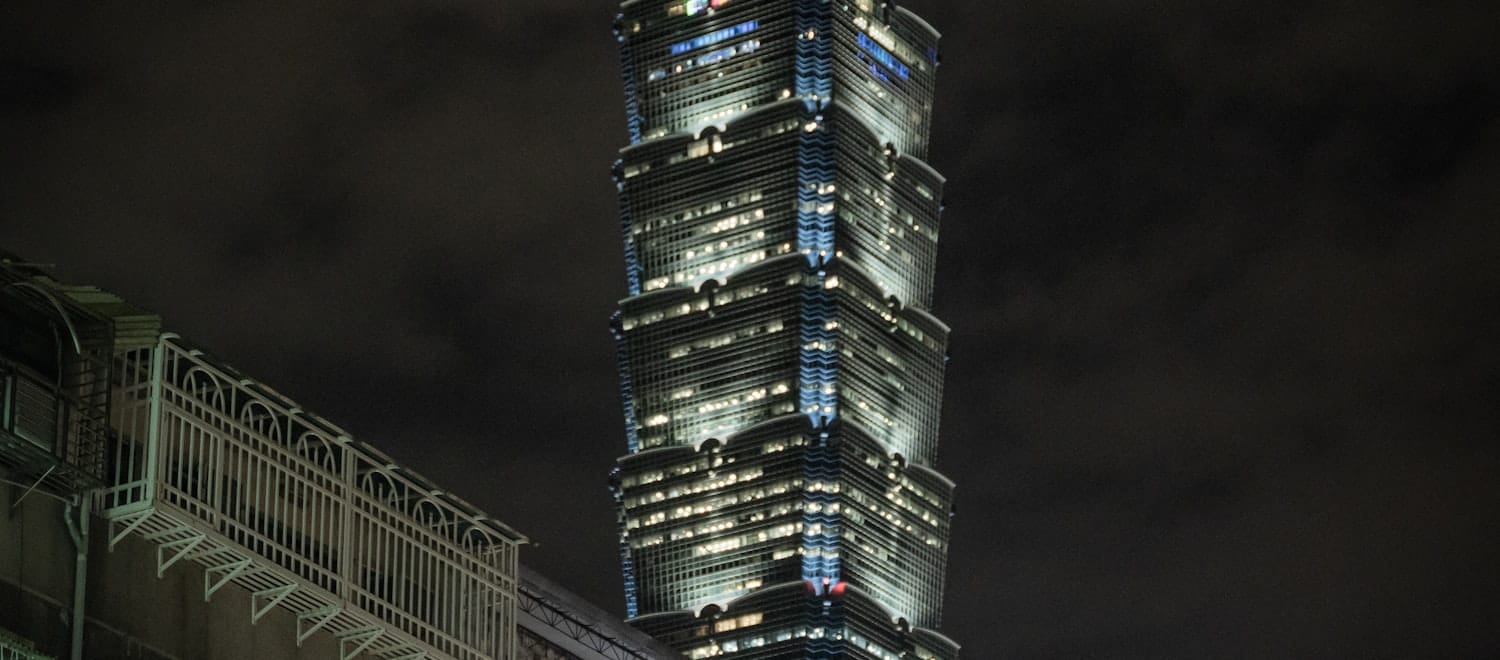
| Taipei after dark — Taiwan’s 2026 peak-load projection (43,010 MW) is climbing ~1 GW/yr against a thin reserve margin. |
| 7. The Energy Constraint — the megawatt is the scarce asset |
| Microsoft’s $80B of Azure demand it cannot serve for lack of power is the cycle’s defining sentence. The slow lever — new generation — doesn’t clear fast: gas-turbine lead times run 7–8 years. The fast lever is verified demand-side efficiency, which is exactly why Section 1 matters. Nowhere is this sharper than Taiwan: Taipower projects a 43,010 MW 2026 peak and ~1 GW/yr of new demand to 2030 from foundry, memory and AI-server build-out, with summer tariffs already live since June 1. In a grid that tight, every rigorously-verified saved kWh is a load-forecast-integrity issue for the operator — not an ESG line item. |
|
|
| 9. The Regulatory Clock |
|
🇩🇪 Germany EnEfG — T-17 days to the Jul 1 2026 ERF ≥10% gate (data centers ≥300 kW), stepping to 15% in 2027 and 20% in 2028; fines reach €100k. Verified energy reuse becomes a build/permit prerequisite, not a virtue. 🌎 SBTi V2.0 remains unpublished and the date guidance has widened again — advisories now span “early” to “late 2026.” V1.3 stays valid for new targets through Dec 31 2027; V2.0 becomes mandatory Jan 1 2028. Lowered urgency, live watch. |
| 10. The PropTech Lens — the twins are getting good (inside the wall) |
| On June 2, Vertiv shipped the first converged physical-infrastructure digital twin for NVIDIA’s Omniverse DSX (its SmartRun system, demoed at Computex Taipei) — power, thermal and operational infrastructure designed and validated as one model before build-out. It joins a deepening roster (Schneider, Siemens, Eaton, Cadence, PTC, et al.). Real capability — but read where it points: every public scope marker stays inside a single AI factory, one owner, one plant. The integrated-FM consensus (“AI as operator, not assistant”) is a tailwind; whole-building, auditable M&V is still the differentiator riding it. |
| 11. The Playbook — how to spec “verified” |
|
1. Require a whole-building baseline, weather-normalized — not a zone-level extrapolation. 2. Demand a dynamic, continuously-updated baseline (the Scientific Reports method), not a static pre/post snapshot. 3. Ask who audited it. Third-party / authority validation (BCA-grade) beats a vendor’s own dashboard, every time. 4. Hold the model to a stated accuracy bar (the study ran <5% baseline error). No stated error = no claim. 5. Capitalize the verified savings only — underwrite the proof, not the pitch. (Robin — CV(RMSE)/NMBE thresholds flagged for your sign-off.) |
|
| 12. Contrarian Corner — the best CRE-tech ground is still above the wall |
| Every new DSX twin — Vertiv this month — makes the same bet: orchestrate brilliantly inside one gigawatt-scale, single-owner AI factory. None of them crosses the wall. The defensible altitude no one is taking is the cross-owner, cross-vendor decision layer above N independently-owned, heterogeneous, mostly-legacy buildings — the commercial stock, not the new-build GPU barns. The more the in-factory layer commoditizes, the more valuable the above-the-wall layer becomes. The smartest 2026 bet isn’t inside the AI factory; it’s the portfolio layer over the buildings that already exist. |
|
| The value isn’t in any one roadway — it’s in the layer that routes across all of them. |
| 13. Tools & The Signal |
|
IPMVP (EVO) — the M&V framework behind the Playbook, free. Pair it with a dynamic-baseline method and a third-party audit and you have the Section 1 reference design. Singapore BCA Green Mark — worth reading even outside APAC; it’s where the auditable-baseline bar is being set this cycle. The Signal (track, not yet urgent): “verified” is hardening from adjective into artifact — the thing you must produce to transact, permit, or refinance. |
| ||||||||||||
| Our Conviction Calls | |
| Four calls we’d put our name on this week. These are opinions, not facts. Hold us to them. | |
|
[HIGH] “Verified” is becoming the asset. Whole-building, dynamic-baseline, third-party-audited M&V is now an evidenced standard, not a pitch — and the spread between owners who can prove performance and those who only claim it is where 2026’s value sits. [HIGH] Power access beats location in data-center-adjacent CRE. Completions doubling into a power-limited grid says underwrite the interconnection, not the dirt. [MED-HIGH] The cross-owner layer stays open. Every new in-factory DSX twin makes the above-the-wall, legacy-stock decision layer more valuable, not less. [MEDIUM] APAC is setting the M&V bar. The reference design for auditable savings came out of Singapore this cycle — watch the standard travel. | |
|
|
The Intelligent Building Brief is free, and that’s the point. If it earned ten minutes of your week, forward it to one colleague who’d say the same. That’s the entire growth plan. — ai-smart-buildings.com |